Foosball Panda

May 21st, 2013

I’m not a big app user. There are so many little applications you can have on your portable hand-held computers (I use the iPod Touch variety) that are mostly distractions from living the life that surrounds you. That being said, I was intrigued by a relatively new app and decided to give it a try the other day. The app in question is Character Design Shuffle created by my pal Stephen Silver.

The idea behind the app is to give you the inspiration to create a random character design. The app has several parameters to suggest what type of physical character it is, gender, outfit, action, age, body type, height, etc. Each category rolls by and stops on some crazy combination that you can then go draw. Some of the suggestions are waaaay out there, so it can be a challenge AND be a lot of fun. Mostly it helps get your brain to think in a way that is different from what it is used to.

So, I gave the parameters a spin and it spit out panda, male, athlete, playing foosball, muscular, and intimidating. This is the result…


Athletic Panda Bear

I might consider subscribing to ESPN if they had interspecies competitive foosball.


Another fun aspect of Silver’s app is that they have a Facebook group (CLICK HERE to see it) where no matter what your skill level, you are encouraged to share your efforts with other users. Pros and amateurs alike have been displaying their inspired creations. Some designs that have been posted will knock your socks off! It is fun to see how this little tool is inspiring some fun drawings.

So, no matter who you are, if you need a little inspiration, check it out and give it a try. Always keep drawing to improve or even develop your skills!

The Boys

May 8th, 2013

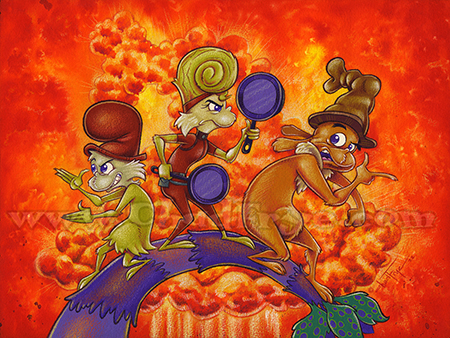
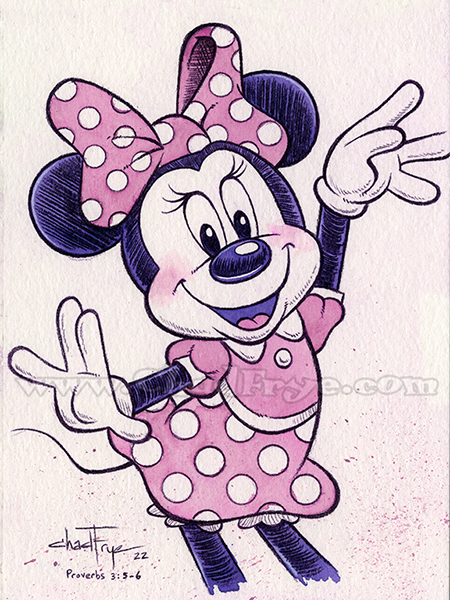
Even though it has been a few years since I worked on a Mickey Mouse project for Disney, I still get a kick out of drawing the gang now and then for friends. This little watercolor sketch was something I did a little bit ago for the first born son of a friend whose friendship began sixteen years ago when we worked side-by-side at Disney Feature Animation.

Thought you all might enjoy seeing it, too.


Disney characters

How a mouse, a dog and a duck ever became best friends is beyond me.

Old Maroon Hot Air Balloon

April 30th, 2013

Last year I gave my father a birthday gift of a hot air balloon ride since it was something he had been wanting to try for awhile. He’s flown in fighter jets, a glider, and sailed the seven seas, but has never sailed through the skies with hot air. Well, not in a balloon at least.

I, however, am not quite the daredevil Dad can be. The notion of a ride in a hot air balloon has a primal romanticism to it, so on that level it has a certain appeal, but bouncing along with the whim of the wind gives me the willies. You never know if you’ll wind up unexpectedly in Oz where you’ll live half your life. I’d rather sprawl out in the shade with a cold lemonade.

That being said, I felt inspired last night to do this sketch. When seated safely at my desk, I don’t mind reaching down to touch the treetops.


hot air balloon

You can almost hear the 5th Dimension as this goes up, up and away. Almost.


Dad is supposed to take his balloon trip soon. He did try it once, but due to winds it was cancelled. I think his is supposed to go a little higher than mine purely for safety reasons. We shall see…

The Ugly Cowboy

April 25th, 2013

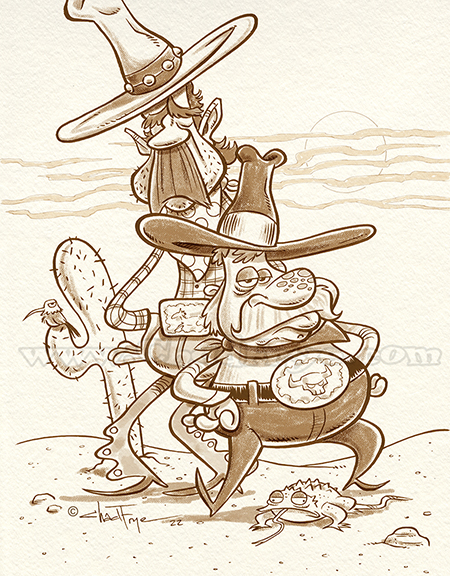
It seems like many western movies, whether from their heyday up until now, the hero cowboys are always chiseled sculptures of men. You know, like Michelangelo’s “David” with a wide brimmed hat and facial stubble. However, all the cowboys in the background and the side players are the ones that were probably most like real cowboys. Yes, folks, we are talking about the ugly ones.

Real cowboys could not possibly have taken care of their teeth very well, or shaved at all out on the trail, taken a bath in weeks, or had proper protection from the sun while out on a cattle drive. They would have been wrinkled, brow beaten, hairy, and very very dirty. Why do you think they kissed their horses? It’s because they were so ugly, the horses were the only ones who didn’t mind the attention.

So, in the spirit of true cowboys, I present to you this mighty ugly hero of the western stage…


Cowboy on the range

I know what you are thinking after what was said above. "How come he doesn't have a full beard?" It is because this cowboy is only 9 years old. Life on the trail is cruel.

Tow Truck Sketches

April 19th, 2013

Yesterday started out like any other: wake up, get lunch put together, shower, get dressed, and take off for work. The trouble was in the “take off” part. There was no “up, up and away” to be had.

You see, I drive an old car. It has served me well as it served my grandmother well before me, and some dude before her. However, yesterday my ’95 Mercury Sable decided to require service of its own. The power would not work at all. So, a tow was required.

While waiting in my car for a tow truck to arrive, I pulled out a trusty thin blue Sharpie marker, and found an old piece of paper in my trunk and began to doodle randomly. There was no rhyme nor reason to the sketching – no frustrated mechanics or dilapidated vehicles. Just some good ol’ fashion creatures. Although if I were to analyze these drawings, I was probably experiencing the disposition of the giant turtle creature while the happy-go-lucky guy inside the jaws was the mechanic about to make some coin.


Big Giant Turtle

Waiting for a tow truck can bring out some weirdness - in a good way.


So, no matter what curve ball life throws at you, with a pen and paper, you can get through it okay. I can’t wait to see what my next jury duty will inspire!

Step-By-Step: Yogi Bear’s Pic-A-Nic – Step 5

April 13th, 2013

So, today we come to the conclusion of the steps it took to create The Pic-a-nic on the Grass, a parody of Èdouard Manet’s The Luncheon on the Grass from 1863. While the background is virtually finished, the characters and some of the foreground elements need to be painted.


Yogi Bear art

The characters and foreground elements receive a bit of watercolor paint.


Color choices were once again fairly easy. Yogi, Boo Boo, the Ranger and Cindy Bear all have predetermined color palettes from their days in the cartoons. The clothing items on the picnic blanket are right out of Manet’s original painting. The basket, food, and checkered picnic blanket were my little doing while keeping in mind the cartoony nature of Yogi Bear’s Jellystone National Park world.

Like with many of the background elements, wet the blank areas with water first, let them sit a minute to allow the water to saturate the paper, then the paint should be applied on those wet areas. The result is a pretty smooth application of color with seldom random edging in the middle of the figures. You can really see in the image below how the transparent nature of watercolor paint allowed for the purple underpainting to show through creating the shading on the figures.


Cindy Bear and Boo Boo with their top layer of color applied with the purple underpainting showing through creating the shadows.


Originally I had thought to use a dark gray/black for the eyeballs and noses of the characters, but upon reaching this point in the work, it seemed best to just darken those areas with purple. My #2 brush was useful for those areas along with the mouth colors.

Do you see the highlights on the noses? During the first pass at painting the noses (which you can see in yesterday’s post), I had left the top areas paper white. In this later step, I painted some purple in lightly, then let it dry a bit. Once it was mostly dry, I went in with a wet brush and applied water, then tamped up the color lightly with paper towel. In essence, I removed some of the purple which helped give the nose highlights a gentle edge and still remain light purple. Sometimes painting is knowing when to remove paint.

So now that everything is painted, it is time to finish this up. This is where I leave painting behind for a bit and rely on drawing skills. For this image, the edges of the characters are going to be defined with colored pencils. Creating a dark line for the characters will help to define them as foreground elements, and it is a common cartooning convention. Once again, I do not use a black pencil, but I do resort to using a dark purple color called Black Grape (#PC996 in the fine line of Prismacolor pencils).


Yogi Bear original art

You can see the colored pencil line is pretty tight, with some sketchiness to help keep things a little loose.


You may notice in these close-ups that there are also some highlights. Those were painted in with some watered down white gouache paint after the dark outline was drawn first. An exception to that is the white on Yogi himself. In his case, I used a white colored pencil for some of his highlights in combination with white paint. The white pencil captured the texture of the paper better.


Yogi Bear & the Ranger

The tough part wasn't creating the highlights, but was trying to keep the real Yogi and Ranger still while they modeled for me.


So, there you have it. That’s how you can create a fun watercolor painting in five easy steps! It is fun to see what looked like a little bit of a mess in Step 3 has now come together all ready for a gallery show. Now you pick a subject and give some of these techniques a try!


Yogi Bear original art

Here is the final 21x17 inch better-than-the-average-bear painting all ready for hanging!

This painting is for sale. Original watercolor image area is 21×17. $2,000 plus shipping. Frame included.

Step-By-Step: Yogi Bear’s Pic-A-Nic – Step 4

April 12th, 2013

Welcome to Step 4 of Build-A-Bear – watercolorly speaking, of course. Yesterday I shared with you the beginning step of applying the color to the background of The Pic-a-nic on the Grass. Since the background is not quite done, shall we continue along that line of thought?

Just as was done yesterday, the rest of the background needs to be fleshed out in shades of green and yellow. The various colors continue to be laid in wet on wet (shorthand for wet paint onto pre-soaked areas of the paper). I have a darker green for much of the foreground section of grass, and an even darker shade that will be dabbed in around the base of the characters to ground them to the — well, to the ground.


Bear in the woods

If a tree is painted in the woods, would a bear notice?


You may have noticed that the trees have also received a bit of paint. Maybe two shades of brown were used on the bark, and a little bit of light green. You really don’t need too many shades of a color because you can control the color’s intensity by how much water is in your brush before you paint. An excess of water makes the color more transparent. The trees further back were painted in lighter to help create that sense of distance. Regarding the cluster of trees on the left side, that one horizontal tree was painted in darker to make it seem like it is more in the shadows.

The large tree on the right I left without brown for now so you can see the green tones put on the bark. The addition of green on the bark helps blend the trees into the scene. There could be multiple lessons on how light affects color, but the shorthand explanation is that colors bounce around in light in real life. It is reflected color. If you stand next to a red car while wearing a light colored shirt, your shirt will look slightly red from the color bouncing off the car in daylight.


painted trees

Here's a closer look at that tree bark so you can have a better idea of how those colors work together to give the illusion of trees. I may have added more purple to the wet brown paint on the more foreground of the three.


Remember how I said in a previous Step that it is wise to paint from the back to the front? You would want to paint in those tree trunks before painting the leaves on the tree because the leaves need to be on top of the wood. It is far easier to paint individual leaves over the wood than it would have been to paint the wood in between all the leaves. No longer working wet on wet, using my trusty #12 Round brush, I began to dab in a few shades of green to build some volume to the leaves.


tree painting

You can see the cluster of leaves on the foreground trees have more individual definition while the green bush below and further away is more generalized with color, and the farthest area has even less detail.


Obviously no longer dominant in the art, hints of that purple underpainting still peek through the greens keeping things a little light and airy. The darker greens are used in the foreground all to maintain a sense of depth. What helps is being able to see that light green peeking through the dark leaves creating a sense that the area behind those trees is getting some sunlight that is not present in the foreground. Once all the tree leaves are painted in, you can really see the composition coming together.


No, it's not a family of polar bears enjoying a summer holiday. Yogi and friends will get the full treatment in Step 5.


I am really a character guy. I work as a character designer in the world of animation after all. So, when you look at the image above, mostly what is left are the characters. I like to think of it as saving the best for last – kind of like eating the icing after you’ve enjoyed the cake.

Come back TOMORROW for the final step in this series on how to create a watercolor painting!

Step-By-Step: Yogi Bear’s Pic-A-Nic – Step 3

April 11th, 2013

Welcome to step 3 of building my traditional watercolor painting of Yogi Bear & Co., The Pic-A-Nic on the Grass. Previous stages in the process that we covered were the drawing/research stage, then the underpainting stage. Today we begin to add color.

If the under painting is the foundation, then today’s application of color is the framework of our construction. The goal is to lay in thin layers of color for atmosphere and to fill in the divots of the paper with color that more detailed painting would not do later on. When you paint, you should always start from the back of the scene to the front. There are several reasons why, most of which have to do with helping you create depth in your work. It helps to build on top of what was done before to create a more lush look by the time the whole painting is completed.

Since this is a parody of a Manet painting, the color palette is somewhat predetermined. Manet figured out the color scheme, so this is just an interpretation of it. I’m not making a direct copy. If I was doing that, then I would be painting in oils and there wouldn’t be a bunch of cartoon bears in the composition. So, when mixing colors, I’m trying to get to the essence of the antique work that has come before.

This is primarily a woodsy scene, requiring lots of green. I mixed about three different shades of green for the trees. Also in the mix are two shades of yellow, and one shade of blue which, oddly enough, is for the sky.

By the way, the painting needs to lie completely flat on a horizontal surface. If you paint with watercolors on a tilted surface, the paint will follow the laws of gravity and streak down your paper. Since we are not creating a rainy day scene, use a flat surface.

I know that I want these colors to blend and mix right on the paper, so to do that, I start applying plain ol’ water with a large brush. I try to apply it mostly to just the white areas because if I get the purple underpainting too wet, that will start to smear. The empty dry patches will be filled in as I apply paint to the wet paper and all will smooth out without smudging the under painting too much.


Yogi Bear painting

In this stage, the base colors begin to be added all swirly-whirly like onto paper pre-soaked with deliberately placed water.


So, with my large #12 brush, I started dabbing in paint onto the wet paper, and spreading it around to my satisfaction. You do need to keep an eye on it while it dries just so that you can control any pooling of paint where it was too wet. If a pool dries, you will get sharp edges of color in that spot that may be undesirable.

You can see in the image above how the purple underpainting shows through. It still has a purple-ish hue, but also takes on the colors of whatever is applied on top. Lots of young artists starting out immediately think that shadows should be painted in with black, but that is not true to life. Shadows are usually darker shades of the color they are shadowing. In art, it can be fun to make shadows a color like I did with purple. There are no blacks in this painting at all.

You can see in the close-up below how the colors blend in spots, and have edges in others. It will all come together later. You can also see some of my original pencil drawing under the paint. If you leave your pencil lines too dark, this will happen. In this case I knew that would happen, and even in the finished art you can still see some of my pencil lines. This was intentional. In this age of so much art being created digitally, I wanted this to completely have that handmade look.


Yogi Bear's Ranger

You can see how the greens blend in with the yellows and blues which is the result of painting with wet paint onto wet paper. Since the purple was pre-painted and dried, the green only covers the purple, not blend in with it. If you work it too much, the purple would start to smear and look "muddy."


So, come back tomorrow to see how the background was finished up!